
Before the Journey Begins
Preparation for the Ayahuasca Retreat
How to prepare for a safe and meaningful experience of depth and inner work
What You Should Know Before Your First Experience
If you are considering an Ayahuasca retreat for the first time, it is essential to inform yourself thoroughly in advance. The internet offers a wide range of information about Ayahuasca—from enthusiastic personal testimonials to more critical perspectives.
As you begin your research, you will notice that there are different forms of Ayahuasca ceremonies. These can vary, for example, in group size, the duration of the ceremony, the style of guidance and who leads the experience—whether an experienced shaman, a medicine woman or a facilitator with their own established practice.
The insights and recommendations we share here are based on many years of personal experience with Ayahuasca, supporting ceremonies and working closely with an indigenous shaman and medicine women.
It’s important to understand: Ayahuasca is not a cure-all and not a “quick fix.” It’s a profound process that requires responsibility, inner readiness and a respectful approach to plant medicine. Conscious preparation, thoughtful integration and a safe, supportive setting are essential for a meaningful and lasting experience.
What to know before, during and after your experience
A Guide to Preparation, Ceremony, and Integration
The Decision to Work with Ayahuasca
A conscious step toward deeper self-awareness
Why a longer Ayahuasca retreat is more beneficial than a weekend experience
Working with Ayahuasca is profound and transformative and it takes time. Time to feel, to integrate and to truly understand. A single ceremony or a short weekend can bring powerful insights, but often there is not enough space to fully absorb what has been experienced.
A longer retreat allows you to step away from everyday life and enter a protected environment where time slows down, distractions fall away and inner processes can unfold naturally. The experiences during ceremony continue to work long after the moment itself—subtle, layered and at times challenging.
The days following ceremony are especially important. The body, heart and nervous system need rest, silence and presence to process what has been experienced. When we immediately return to daily routines — thinking, planning, and functioning — much of the depth can be lost.
A longer retreat creates the opportunity to reflect, to process, and to ask questions in the support of experienced facilitators, without rushing into mental analysis. Many of the insights from this work do not arise in the mind, but in the heart.
Integration begins with feeling. And for that, space is essential.
Master Plants and the Wisdom of Plant Medicine Traditions
Master plants (also called “teacher plants”) hold a special place in many indigenous traditions. They are said to fulfill two central roles for human beings: to heal and to open.
As healers, they work on the body, mind,and spirit. They help to release deeply held blockages, touch emotional wounds and set physical processes in motion that have long been stagnant.
As keys, they open perception. They expand consciousness, allowing us to access hidden layers of the self and to come into contact with spiritual or non-ordinary dimensions of reality.

Preparing for Your Ayahuasca Retreat
— Safety, Intention and Inner Alignment —
The work with Ayahuasca does not begin with the ceremony itself. It begins with a conscious and mindful preparation. A good preparation lays the foundation for a deep and safe experience.
Once you have decided to embark on this journey at our Ayahuasca center and your intention has become clear, you will receive a detailed questionnaire. This primarily includes questions about your physical and psychological health, as there are certain medical and psychological exclusion criteria. Your wellbeing and safety are our highest priority.
In some cases, we also conduct a personal video call to clarify open questions and to support you in a more individual way. If there are no medical concerns, you will receive further guidance on how to prepare for the ceremony—so you can benefit as fully as possible from the experience.
The Importance of the Ayahuasca Diet – Preparing Body and Mind
A central part of the preparation is the so-called Ayahuasca diet. In traditional cultures, especially in Peru, this diet (“La Dieta”) is an ancient ritual of purification that prepares both the body and the energetic system for ceremony.
You will receive a detailed list of foods, substances, and habits to avoid before the ceremony—including certain animal products, alcohol, medications, stimulating substances,and sexual activity.
The diet helps to cleanse the body, increase psychological sensitivity, and deepen your connection to your inner world. Many participants report that they already begin to open emotionally during this phase and become more consciously aligned with their intention. On the day of the ceremony itself, your last meal should be taken 4–6 hours before the start.
Arrival & Pre-Ceremony Introduction at the Retreat Center
After your arrival at our center, the next phase of preparation begins:
a personal introductory conversation with the facilitators. We take time to understand you, your current inner state and the group you will be sharing this experience with.
This conscious arrival creates trust, strengthens the sense of community and offers space for any final questions, uncertainties or clarifications.
The Ceremony
The Ayahuasca ceremony takes place in our Oca a safe, structured and carefully prepared environment. The setting is designed to support the process with clear guidance, stability and continuous attention from experienced facilitators.
Each ceremony begins with a short introduction. This helps participants arrive in the space, become present and orient themselves within the group setting. It is also a moment to reflect on the personal intention for the ceremony. The intention serves as a point of inner focus without defining or controlling the experience.
After the medicine is served, the ceremony continues in an inner observation. The experience is individual and can unfold in different ways, ranging from calm and reflective to emotionally or physically more intense phases.
A ceremony typically lasts between 4 and 6 hours. Throughout the entire process, facilitators remain present to ensure safety and provide support when needed.
The structure of the space allows participants to engage fully with their experience while remaining in a secure and held environment. After the ceremony, time is provided for rest and recovery, allowing the process to settle and begin integrating naturally.
The Integration after the Ayahuasca Ceremony
The Ayahuasca ceremony is a powerful process, but the deeper work often begins afterwards. Integrating the experience into everyday life is an essential part of the journey and support continues beyond the ceremony itself.
After each ceremony, time is set aside for a gentle transition. Within a safe and supportive space, participants are invited to let the experience settle, share impressions and gradually make sense of what has unfolded. This can take place through conversation, quiet reflection, or other forms of personal expression, always with attentive guidance.
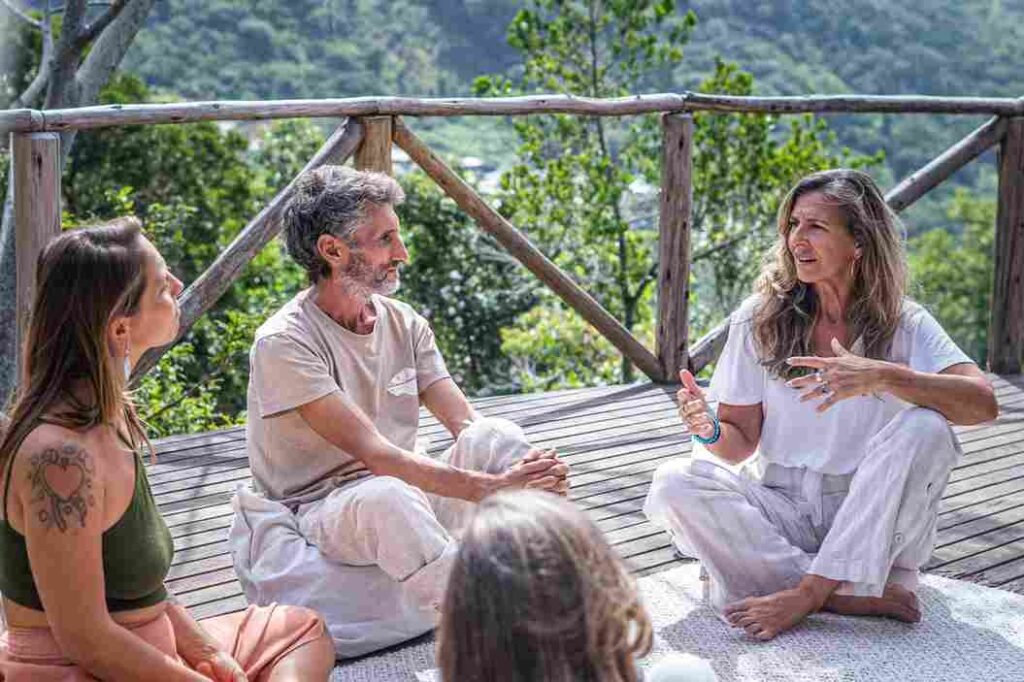
Real transformation does not happen only during ceremony, but in the way the experience is brought into daily life. This integration phase is supported with experience, care and openness for whatever needs attention or clarity.
Ready to Begin Your Preparation?
if this experience resonates with you, the next step is to explore the retreat details and see if it feels aligned.